
Tags
God’s Battle Plan for the Mind: The Puritan Practice of Biblical Meditation, by David W. Saxton
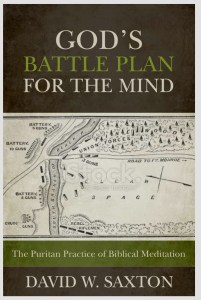 Might as well do a book review, right? I mean, I do book reviews on everything I read for my own personal edification and memory. I’ll share some of them.
Overall, God’s Battle Plan for the Mind a good book. He begins by explaining not just the importance of Christian meditation, but bolsters his argument by diving into a multitude of Puritan authors and preachers and their insistence of it’s importance. Christian meditation is a practice that is nearly lost in modern times. Christian meditation is such a lost part of the Christian walk, that the Christian who presents himself as “one who meditates” is generally regarded as mixing Buddhism into their walk. Yet Christian meditation is nothing like Buddhist practices. Christian meditation does not turn inward to watch breath, or a repeated mantra, but upon something outside himself-specifically the nature and character of God.
He does a good job of going through quite a few Puritan authors, looking at what they called Christians of their time to do. And to be honest, it’s really a completely different concept of a Christian walk than we have today.
We are distracted today by cell phones and Facebook and any TV show in all of history in multiple languages all within a couple of clicks from right where we are. On the couch, in bed, at the airport, at work. So we have all of that distraction, and we fail to focus on the thing-the One Thing- that will make all the difference in our lives, which is Christ.
The book is useful, in that it identifies the problem (Christians no longer meditate), and then provides a plan to teach modern distracted Christians how to move forward and recover this practice. He provides some definitions of what Biblical Meditation is and is not, as well as the difference between occasional and deliberate meditation.
One of the most helpful chapters is regarding what it is we can meditate on. Not just random bible verses but bible verses, nature, and the character and nature of God.
And then of course, the benefits of meditation. The stakes of meditation are high, and the Christian who does not meditate, is likely not a Christian at all. This is simply a logical conclusion-if we never consider who God is, what he does for us, the way He acts… well, what are we meditating on? The best beers? The best tv show? How to get more money? These are things that may be worthy to consider, but if we don’t focus our thoughts on the most powerful being in the universe, what does that say about how we consider ourselves?
Overall, I have to say, this was a good book. Helpful. I can see much more clearly how empty we are without Biblical Christian meditation, and why it would be better to put down some distractions and look to Him instead.
Star Rating: ☆☆☆☆
 The Nelson Chronicles