• About Us
  • Rules for Comments

The Nelson Chronicles

~ Family, Marriage, Adoption

The Nelson Chronicles

Category Archives: Book Review

Book Review: God’s Battle Plan for the Mind

25 Saturday Feb 2017

Posted by Dan Nelson in Book Review, Christianity, Family Life

≈ Leave a comment

Tags

Books, Meditation, Puritan

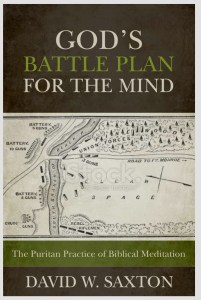
God’s Battle Plan for the Mind: The Puritan Practice of Biblical Meditation, by David W. Saxton 

img_0193Might as well do a book review, right?  I mean, I do book reviews on everything I read for my own personal edification and memory.  I’ll share some of them.

Overall, God’s Battle Plan for the Mind a good book. He begins by explaining not just the importance of Christian meditation, but bolsters his argument by diving into a multitude of Puritan authors and preachers and their insistence of it’s importance.  Christian meditation is a practice that is nearly lost in modern times.  Christian meditation is such a lost part of the Christian walk, that the Christian who presents himself as “one who meditates” is generally regarded as mixing Buddhism into their walk.  Yet Christian meditation is nothing like Buddhist practices.  Christian meditation does not turn inward to watch breath, or a repeated mantra, but upon something outside himself-specifically the nature and character of God.

He does a good job of going through quite a few Puritan authors, looking at what they called Christians of their time to do. And to be honest, it’s really a completely different concept of a Christian walk than we have today.

We are distracted today by cell phones and Facebook and any TV show in all of history in multiple languages all within a couple of clicks from right where we are. On the couch, in bed, at the airport, at work. So we have all of that distraction, and we fail to focus on the thing-the One Thing- that will make all the difference in our lives, which is Christ.

The book is useful, in that it identifies the problem (Christians no longer meditate), and then provides a plan to teach modern distracted Christians how to move forward and recover this practice.  He provides some definitions of what Biblical Meditation is and is not, as well as the difference between occasional and deliberate meditation.

One of the most helpful chapters is regarding what it is we can meditate on.  Not just random bible verses but bible verses, nature, and the character and nature of God.

And then of course, the benefits of meditation.  The stakes of meditation are high, and the Christian who does not meditate, is likely not a Christian at all.  This is simply a logical conclusion-if we never consider who God is, what he does for us, the way He acts… well, what are we meditating on?  The best beers?  The best tv show?  How to get more money? These are things that may be worthy to consider, but if we don’t focus our thoughts on the most powerful being in the universe, what does that say about how we consider ourselves?

Overall, I have to say, this was a good book. Helpful. I can see much more clearly how empty we are without Biblical Christian meditation, and why it would be better to put down some distractions and look to Him instead.

Star Rating: ☆☆☆☆

Spread the Word:

  • Share on Facebook (Opens in new window) Facebook
  • Share on X (Opens in new window) X
  • Email a link to a friend (Opens in new window) Email
Like Loading...

The Bruised Reed

02 Friday Jul 2010

Posted by Dan Nelson in Book Review, Christianity

≈ Leave a comment

I was reading The Bruised Reed by Richard Sibbes with the “Reading Classics Together” group over at Tim Challies’ blog but I fell behind! So even though it’s a little bit late (okay, a few weeks late), here are my thoughts about the book.
This really just an excellent book. I can see why it is being printed 380 years after it was originally published. I know that many have recommended reading books by the “old dead theologians,” and I’m beginning to see just why that is, after recently finishing Bunyan’s Pilgrim’s Progress and now Sibbes’ The Bruised Reed.
The book offers solid encouragement, describes the Christian walk and growth (or lack thereof) in some of the easiest to understand imagery I have encountered. It was as though it put all of these thoughts that I had been gathering over the past couple of years and describing them in a way that I could not put to words. I kept finding myself saying, “Yes! That’s exactly what I thought!” or “That makes so much more sense now!” (With the exclamation points).
I have used his descriptions of the bruised reed and smoking flax and Christ’s use of judgment in his government which reigns over individuals repeatedly over the past two months in my lessons at church and in conversation. I have underlined more of this book than probably any other I own, and I intend to reread it.

The chapters are:
1.The Reed and the Bruising
2. Christ Will Not Break the Bruised Reed
3. The Smoking Flax
4. Christ Will Not Quench the Smoking Flax
5. The Spirit of Mercy Should Move Us
6. Marks of the Smoking Flax
7. Help for the Weak
8. Duties and Discouragements
9. Believe Christ, Not Satan
10. Quench Not the Spirit
11. Christ’s Judgment and Victory
12. Christ’s Wise Government
13. Grace Shall Reign
14. Means to Make Grace Victorious
15. Christ’s Public Triumph
16. Through Conflict to Victory

Sibbes describes the Christian as a “bruised reed” and the presence of the Spirit within us as the “smoking flax,” taken from Isa 42:1-3: “A bruised reed shall he not break, and the smoking flax shall he not quench: he shall bring forth judgment unto truth.”
He offers why we are bruised but not broken and why the smoking flax, though perhaps only a smoldering ember rather than a great flame, will never be quenched. He explains how Christ displays his knowledge leading to proper judgment by those he raises up to establish his government within them. He also describes hallmarks of a Christian as the bible describes, not as the modern American church describes. (Which I’ve written about in the past). He also illustrates the struggles that come with it and how to deal with those doubts and discouragements. Some of my favorite quotes about this:

“It takes much trouble to bring Christ into the heart, and to set up a tribunal for him to judge there. There is an army of lusts in mutiny against him. The utmost strength of most men’s endeavors and abilities is directed to keeping Christ from ruling in the soul.”

“…the desperate madness of men is laid open, that they would rather be under the guidance of their own lusts, and in consequence of Satan himself, to their endless destruction, than put their feet into Christ’s fetters and their necks under his yoke; though, indeed, Christ’s service is the only true liberty.”

“Since there is such comfort where there is little truth of grace, that it will be so victorious, let us often try what God has wrought in us, search our good as well as our ill, and be thankful to God for the least measure of grace, more than any outward thing. It will be of more use and comfort than all this world which passes away and comes to nothing… See a flame in a spark, a tree in a seed. See great things in little beginnings. Look not so much to the beginning as to the perfection, and so we shall be, in some degree, joyful in ourselves, and thankful to Christ.”

I also love his description of how Christ changes us and conforms us better to His image-how he does it, why we mess it up, and why it is important to know:

“…Christ brings about all that is good in the should through judgment, and that so sweetly that many, by a dangerous error, think that good which is in them and issues from them is from themselves, and not from the powerful work of grace. So it is in evil, where the devil so subtly leads us according to the stream of our own nature that men think that Satan had no hand in their sin; but here a mistake is with little peril, because we are evil of ourselves , and the devil only promotes ill he finds in us. … Now when he clearly reveals what is good in particular, we are attracted to it; and when he shows us convincingly what is evil we abhor it as freely as we embraced it before. From this we may know whether we work as we should or not.”

If you have the opportunity to read this, I highly recommend it. You can purchase it through Westminster Books  or Monergism Books.  Both sell it for under $5.
If you like you may read it online at monergism.com.

Spread the Word:

  • Share on Facebook (Opens in new window) Facebook
  • Share on X (Opens in new window) X
  • Email a link to a friend (Opens in new window) Email
Like Loading...

Book Review: So You Don’t Want to Go to Church Anymore

07 Wednesday Apr 2010

Posted by Dan Nelson in Book Review, Christianity

≈ Leave a comment

Someone gave this book to my wife a few months ago, and said that we just had to read it. He said that what we are describing in our own spiritual journey sounds a lot like what is in the book So You Don’t Want to Go to Church Anymore by Wayne Jacobsen and Dave Coleman. My immediate reaction was, “But I do want to go to church- I really want to go to church.” I had apprehensions about the book for a couple of reasons besides the title. First it contains an advertisement for The Shack. Lots of red flags go up in my mind- The Shack was the most painful thing I’ve ever read.  Secondly, the pages of “What others are saying about” the book are just not very helpful.  They are random statements from people I have no idea if I can trust, and some I know I can’t trust just by what they say.  One stated “These writings are more than a book. They are a living two-edge sword, God revealing himself…” which is a sure sign of someone who doesn’t know the difference between scripture and a fictional story. Yet I trusted my friend and read the book.
So You Don’t Want to Go to Church Anymore tells the fictional story of Jake, a burned out pastor who wants more out of his relationship with Christ. In the middle of some tough times a man named John, who just might be the actual apostle John (wink), enters Jake’s life and starts giving him some direction. The story follows snapshots of Jake’s life as he encounters John over the course of a few years and Jake follows his spiritual journey.

I have mixed feelings about the book. The dialog is a bit choppy and sometimes forced at times. The flow of the book isn’t difficult to follow, but doesn’t really flow well. It starts at the time of a crisis with his daughter, and implies that he is looking back at the events, but the crisis shows up in the middle rather than the end of the story.

Those minor issues aside, the book provides some very provocative thoughts about following Christ and why it can’t be done (or at least can’t be done very well) in the institutionalized church.  There is much they have to say that I had to fully agree with, but they took it to such an extreme that I can’t agree with a lot of what they have to say.  They simply take it too far.  The theme of the story is that serving Christ isn’t the same as serving the church, and serving the church actually hinders or entirely prevents the ability to truly follow Christ.  When we serve the church as an institution, it becomes a burden and ties us to the institution and restrains us from serving Christ as He leads us.   They use examples of Sunday School as rewarding those who follow the system rather than Christ, recurring broken relationships between those in the church fighting to keep their particular program in place or the facade of themselves looking good or the facade of the church looking as being a hindrance.  And I agree that all these things exist.  Yet the authors attack not just the problems that churches experience, but any kind of structure or organization of a church, even to the point of a church body actually meeting.

They picture the church as a free-floating, come-as-you-go spiritual journey with absolutely no structure, no accountability (the thought of being accountable to others they claim is unbiblical), and no set meeting.  The church to them would be a group of always changing relationships with no obligations to one another, except as they are led by the Spirit.

I don’t believe this is the biblical model of the church.  Yes, there is organization to the church.  No, it doesn’t need to have a staff of dozens to operate.  Might it?  Yes, but their argument is that when you get to a certain point you begin to defend the institution and programs rather than what Christ says you should do.  This may happen, but just because it might happen and sometimes does happen doesn’t mean that it will.  If God did not intend for us to gather, why would we be given instructions as to how to organize the church and defend doctrine?  Isn’t that the main focus of the letters to Timothy?  Why would Paul tell him to appoint overseers?

I think what the book does a good job of pointing out that in our endless committee meetings and programs we spend so much time and effort bogged down with sustaining them we lose sight of our first love.  What it fails to address with the institutionalized church is that it is often being run by those who have no idea what they are doing.  (Not usually the pastors, but many of the church members).  In this they are seeing a problem, but trying to fix it in the wrong way.  They touch on this issue,  as in this example during a conversation between Bryce, a friend of Jake, and John:

[Bryce says] “…The people whose spiritual maturity I respect most seem to gravitate away from helping us run this thing [the church].  I’ve been very disappointed that they won’t join our leadership teams.  It means we have people in leadership positions who don’t know God very well, but who have strong opinions about the way things should be.”

“That should tell you something.” [John responds]

“It tells me that maybe the ones I thought were mature aren’t, since they were so unwilling to serve us.”

“Okay, that’s one possibility, or maybe they wanted to invest their time serving people instead of attending an endless supply of committee meetings.”

The implication of the dialog is that whoever becomes mature leaves the “organization” of the church, as though becoming wiser in Christ will make them break free from the chains of oppression that the church places on people, to which I disagree.  And yet they make a good point-“there are people in leadership positions who don’t know God very well,” but come to the wrong conclusion that everything about the church and its organization and structure must be thrown out.

I think the problem they are overlooking is that our churches are filled with the unregenerated.  People who think they are Christians but are not.  I don’t think it is the fault of any “structure” but that we accept anybody with a pulse who says “I believe” as an active voting member of the church with no attempts made to explain doctrine or to discern if they are saved or help them discern if they really are Christians.  (Even demons are “believers.”)  Our church buildings are full of people such as this (and I will add that I was one of them for a long time).  The problem the authors are trying to address throws out the baby with the bath water in a sense.  The problem isn’t the church, the problem is what we call the church.

The longer I type the more I realize how deep this hole goes!  To wrap things up, these are the things I like about this book:

  • It makes you consider how much time you are spending tied down to responsibilities (i.e. programs/church meetings) rather than following Christ.
  • Because the main character is a pastor who struggles with keeping his job and appeasing the masses versus following what God says, it makes you look at what flaws may exist in our churches and the dangers to those pastors we highly regard.
  • It truly makes you question if what you are doing is because it is comfortable, because you are trying to control your own life, or if you are really honestly allowing God to take over.
  • It does a great job of pointing out that those who leave the church to join the house church movement, or to form a church of their own often fall back into the old problems of being tied to programs and meetings because they are focused on the church and have lost sight of Christ.  It is a great warning for those who are considering moving in that direction.
  • It is entertaining and easy to read. (I read it in a day).

And what I don’t care for about the book:

  • It simply goes too far in trying to abolish any sense of a church outside of “conversations” or friendships.  Those things are deeply important, but they aren’t the only things that are important.
  • It attacks the problems seen in our church buildings today (which is good) but comes to the conclusion that churches should not exist in any (that’s A-N-Y) structure rather than seeking to correct why the problems exist.

Overall, do I recommend you read it?  It depends.  I recommend it to a mature Christian who isn’t going to be “tossed to and fro by the waves and carried about by every wind of doctrine” (Eph 4:14).  It does help show flaws in the church that should be addressed, and really does help shed light on how God changes lives differently in everyone, even though we can’t see Him working until much later.  I recommend that a new believer not read it, because I fear it may be difficult to discern truth and simply be too confusing for them.  If someone who is just coming to Christ they could (at worst) look at it and actually forsake the assembling of the saints, which I fear would lead them further from Him.

Spread the Word:

  • Share on Facebook (Opens in new window) Facebook
  • Share on X (Opens in new window) X
  • Email a link to a friend (Opens in new window) Email
Like Loading...

Book Review: The Exemplary Husband

22 Tuesday Dec 2009

Posted by Dan Nelson in Book Review

≈ Leave a comment

I’m not going to say The Exemplary Husband is the best book I have ever read.  But after I read it I gave my copy away and bought eight more.

I thought it would be a good book, based on the fact that Paul Washer said in a sermon that everyone needed to read it.  I have come to become very grateful for teachers like Paul Washer, and I was not disappointed by this recommendation.  The Exemplary Husband: a Biblical Perspective by Stuart Scott is an excellent book about what the bible says about being a husband.  Most books tend to look at practical ways to be a good husband.  That is good and helpful, but if you don’t have the foundational doctrines as to why you should act in that way, then you are really just trying to “be good” (and often for the wrong selfish reasons).  We are called as husbands to love our wives as Christ loves the church.  But how?  How do we love our wives as Christ loves the church?  More importantly, why are we to do it?  Is it just a nice thing to do?  Or does it go much deeper than that?

The biblical expectations of a husband are clear in the bible, but in our society many of the passages pertaining to the relationship of man and wife are distorted.  We have the wrong view of what is expected of a man, what is expected of a woman, and then try to pick out the verses that best suit our needs.  This book helps to address this by taking a systematic approach to what the bible says about Christians, God, Husbands, and Wives.

He starts with the basic of the basics of Christianity.  In it he proceeds to lie down the foundations in a concise and straight-forward manner.  Scott starts by describing who God is and how He describes Himself in the bible.   He addresses what the bible says about the trinity and God’s attributes; man’s condition and God’s provision for them and the relationship God provides for us with Him and within the family.  And that’s just the first section.

He also looks at the responsibilities of the husband.  Why and how we worship and love God.  What leadership means as it pertains to a godly husband, what our biblical role for physical intimacy is, and what the bible says about stewardship of our time and money.  I found the section on leadership to be especially helpful, because most of what we hear about when it pertains to leadership in the family is through the filter of the world.  My upbringing taught me to be an incredibly passive man, and it truly helped me to understand what I must do to lead my family. It is not a book about how to be a leader who commands all to bow before him, but teaches men to be servant leaders to their families.

He continues with a discussion of the “fundamental commitments” of an exemplary husband, exploring how vital humility is in our relationships with our wives.  Also addressing what it means to be sensitive, how to help your wife deal with sin, communication, and resolving conflicts.  We are not to be Caesars over our families, we are to be loving and humble servants.

The last section is about “fatal sins” of an exemplary husband, and shows how we cannot let anger, fear, anxiety, or lust get in the way of our role as godly leaders of our homes.

Each step of the way, Dr. Scott takes care to address view that are incorrect.  He addresses various wrong views of God and wrong views of man’s condition.  He takes into account that while we may have the best intention when we look at how to be a good husband, we may not, and we may be confused on the topic because of how our society views the marriage relationship.  An excellent example is in his chapter on “Helping His Wife Deal With Her Sin” he makes it very clear that the husband must take care to look at his own sin first, while pointing out that not helping your wife with her sin is, in fact,  sinful.

I learned greatly from this book, and it has helped me to put many things that

I knew I should be working on and understanding the perspective as to why I should act as a Christian.  Each page of the book gave me a peaceful relief as I read.  Nearly every day I would go to my wife and tell her what I learned from it, or ask her questions prompted by the book.  By reading this book, you will understand man’s role in marriage and the biblical perspectives behind it.  This will not only serve to strengthen your marriage, but all of your relationships, including your children, other christians, non-believers and with God.  It lies down the foundations so that someone who is new to the faith will gain an understanding of Christianity and the man’s role in his day-to-day life, and thorough enough that a mature believer will be challenged.  It could be looked at as the systematic theology of a husband’s role in marriage.

Dr. Scott mentions that his The Exemplary Husband and The Excellent Wife by Martha Pearce are companion books.  I will trust that her book would be a good source for wives as well.  I highly recommend this to all men- those who are struggling in their marriage, those with a solid marriage, or those who think someday they might get married.

Spread the Word:

  • Share on Facebook (Opens in new window) Facebook
  • Share on X (Opens in new window) X
  • Email a link to a friend (Opens in new window) Email
Like Loading...

Archives

January 2026
S M T W T F S
 123
45678910
11121314151617
18192021222324
25262728293031
« Mar    

Blogroll

  • Called to Worship
  • Following the Will of God to Russia
  • One Peaceful Place
  • Ordinary Pastor
  • Pavement Ends
  • Team Pyro
  • Tim Challies

Enter your email address to subscribe to this blog and receive notifications of new posts by email.

Join 266 other subscribers

RSS Feed

RSS Feed RSS - Posts

Top Posts

  • None

Tags

4th of July Adoption Adoption after one year Adoption help Adoption language Alone Arbat Street Attachment disorder Birthday Camping Child of God Children Chocolate Bunny Christ and Bride Christian Christmas Cocooning Deeper Conference Depravity Digital Journaling Discernment Dye allergies Easter Eng-russky Engrussky Ephesians 5 Extreme Strollering Family Fireworks Gospel Gotcha day Halloween Holiness Home Humanity International Adoption Jesus Journaling Journaling 101 Jumpoline Koopatsah Marriage Mispronunciation Mocow Moscow Nate New Website New Words Paleo Parenting Pekin Perekhod Photos Pictures Playground Russian Post adoption Psalm Psalm 2 Pumpkin Patch Red Square Russia Russian adoption Russian Drivers School Sea of Japan Silly Six Months of Adoption Sovereignty of God Spurgeon Surgery Tempation Unmommy time Vladivostok Vocabulary Welcome

Categories

Adoption Bible Study Book Review Books Christianity Christmas Dogs Family Family Life Journal 27 Journaling Odds & Ends Paleo Photos Prayer Reading Classics Together Russia Sermon Uncategorized

Twitter Updates

Tweets by erphed

Archives

  • March 2017
  • February 2017
  • January 2017
  • April 2015
  • March 2014
  • February 2014
  • December 2013
  • July 2013
  • March 2013
  • December 2012
  • July 2012
  • May 2012
  • April 2012
  • February 2012
  • September 2011
  • May 2011
  • April 2011
  • March 2011
  • November 2010
  • October 2010
  • September 2010
  • August 2010
  • July 2010
  • April 2010
  • March 2010
  • February 2010
  • December 2009
  • October 2009
  • September 2009
  • August 2009
  • May 2009

Helpful Websites

  • Deeper Conference
  • Lifehacker
  • Sovereign Grace Baptist Church
  • The Lord's Table
  • Together for the Gospel
  • Way of Purity

Recent Posts

  • Book Review: Do More Better
  • Book Review: God’s Battle Plan for the Mind
  • I Have a Blog?
  • My Favorite Place 
  • On Journaling, Part 2: Digital versus Paper

Enter your email address to subscribe to this blog and receive notifications of new posts by email.

Join 266 other subscribers

Create a free website or blog at WordPress.com.

Privacy & Cookies: This site uses cookies. By continuing to use this website, you agree to their use.
To find out more, including how to control cookies, see here: Cookie Policy
  • Subscribe Subscribed
    • The Nelson Chronicles
    • Already have a WordPress.com account? Log in now.
    • The Nelson Chronicles
    • Subscribe Subscribed
    • Sign up
    • Log in
    • Report this content
    • View site in Reader
    • Manage subscriptions
    • Collapse this bar
 

Loading Comments...
 

    %d